

AI Bullet ANPR Specialist
The dedicated ANPR camera in the AI Bullet range. A 90 fps frame rate — more than triple the standard — captures plates clearly on dual carriageways and urban motorways at 70 mph, where slower cameras blur. 140 dB Super WDR stops oncoming headlights from blowing out the plate. 50 m smart IR floods retro-reflective UK plates with the 850 nm wavelength they're designed to return. Optimised for one job: pixels per metre across the plate, at speed, day and night.
Three ways a standard camera fails at night-time ANPR.
Speed blur. A 25 fps camera captures one frame every 40 ms. At 70 mph — around 31 m/s on a dual carriageway or urban motorway — a vehicle moves more than a metre between frames. The plate is sharp in one frame, smeared in the next, or in neither at the angle the AI model wants.
Headlight blow-out. Oncoming or trailing headlights overwhelm a standard sensor's dynamic range. The lit area saturates white, the plate next to it disappears into the burnt-out region, and the ANPR read fails.
Ambient darkness. Below street-lighting level the plate isn't lit at all. Without active illumination, no usable plate exposure exists.
The CA-1050 solves all three together. 90 fps with shutter to 1/100 000 s holds detail at motorway speeds. 140 dB Super WDR preserves the plate alongside headlight glare in the same frame. 50 m 850 nm smart IR floods retro-reflective plate fill in pure darkness — invisible to drivers.
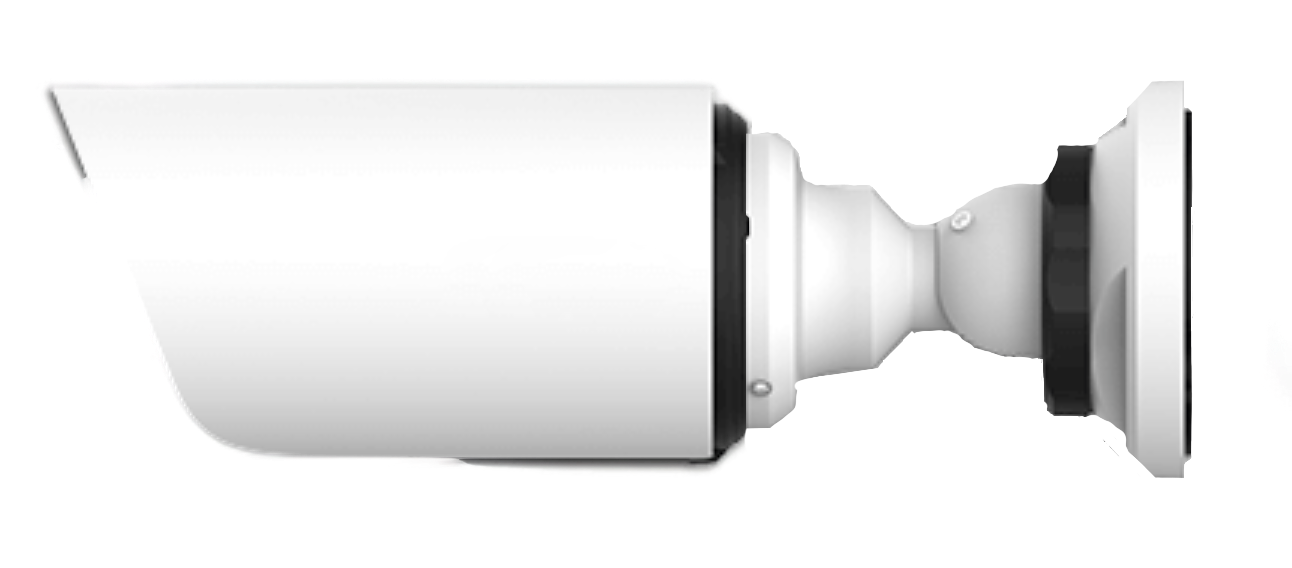
Frame rate, dynamic range, IR reach — the three ANPR specs that matter.
5× motorised zoom (2.7–13.5 mm) for plate-window focus. F1.4 P-Iris. 50 m smart IR. 90 fps PAL/NTSC at 1080p. 140 dB Super WDR. Multi-tail cable on a single Cat5e tail. ONVIF Profile S / T / G / M plus extended vendor event API for plate events. Pairs with a NOW Wireless AI box or the SenseView server for plate enrolment, DVLA cross-reference and journey-time pipelines.
- Frame rate
- 90 fps
- WDR
- 140 dB
- IR reach
- 50 m
- Zoom
- 2.7–13.5 mm
- Sensor
- 2 MP · 1080p
What the hardware does.
90 fps freezes motion at 70 mph
Three times the frame rate of a standard 25 fps camera. The shutter can run down to 1/100 000 s. A vehicle travelling at 70 mph on a dual carriageway or urban motorway moves about 34 cm per frame at 90 fps — small enough that the plate stays sharp through the read window. The same vehicle at 25 fps moves 124 cm between frames; the plate smears.
Useful for trunk roads, signalised junctions on green-phase clearance, and pursuit-grade evidential capture.
50 m IR and 140 dB WDR — the night-plate combo
Night-time ANPR has two failure modes. The plate is too dark to see — solved by IR flooding. Oncoming headlights wash out the same frame the plate is in — solved by Super WDR. The CA-1050 handles both at once.
The 50 m 850 nm smart IR illuminator fills the plate window with the wavelength UK retro-reflective plates are designed to return. The plate lights up in the IR even when ambient is zero. 140 dB Super WDR — among the widest dynamic range in the camera range — keeps the lit plate readable next to oncoming headlights, tunnel mouths, or low-sun glare across the lens.
Smart IR adjusts intensity to the zoom level — no overexposure of close objects when zoomed in. 850 nm is invisible to drivers and pedestrians; warm-white supplement disabled by NW policy.
Zoom concentrates pixels on the plate-readable window
ANPR doesn't need a wide field of view — it needs enough pixels per metre across the plate window for the model to resolve characters. The 5× motorised zoom (2.7–13.5 mm) lets the camera be tuned to the exact plate-distance the install needs: 20 m, 35 m, or 50 m at the far end. F1.4 P-Iris holds exposure steady as the focal length changes.
The 2 MP sensor is deliberately matched to the ANPR job — more megapixels would be wasted at the narrow end where the lens already concentrates 1080p onto a plate-sized region.
Three ways to deploy this camera.
The CA-1050 supports all three deployment modes. Mode A is straight evidential capture. Mode B publishes on-camera plate-window detection to SenseView at low bandwidth. Mode C feeds the full 90 fps stream into a NOW Wireless AI box for plate enrolment, DVLA cross-reference and journey-time pipelines.
Capture & stream
Camera publishes the live 90 fps 1080p stream. Local storage on microSD, central NVR, roadside cabinet or cloud. No AI inference at the camera — pure capture and stream.
Smart events → SenseView
The camera runs vehicle and plate-window detection on-board. Line cross, region entry and tamper events publish to SenseView over standard event channels — plate enrolment and DVLA cross-reference run upstream on the AI box or SenseView server.
Video → AI box → SenseView
Full 90 fps stream to an Nvidia-based AI box in the roadside cabinet, control room or cloud. The AI box runs plate enrolment, DVLA cross-reference and journey-time classification, then feeds SenseView. Full feature set available.
What the AI platform adds.
The camera delivers clean plate-readable frames. SenseView turns those frames into enrolled plate records, DVLA-cross-referenced vehicle data, and journey-time and origin-destination data — running at the edge on a NOW Wireless AI box, or centrally on the SenseView server. The CA-1050 is built to feed these workflows.
Traffic
- ANPR with DVLA cross-reference — type, licence, MOT, emissions, fuel, weight, year, engine
- Journey times and tracking — Bluetooth + ANPR, journey-time, start/end, Anywhere-to-Anywhere
- Counting and classification — vehicles, cyclists, pedestrians on roads, cycleways and pavements
- Pollution-charging-zone enforcement — plate enrolment at scale
- Turn analysis, desire lines, junction analysis
- Virtual loops — overhead detectors replacing in-road inductive loops without roadworks
- Cross-city tracking — passive Bluetooth Digital Signatures + ANPR
Security
- Investigation-grade plate evidence — date, time and plate accuracy
- Anti-social driving capture — speed, plate, vehicle type
- Police investigation workflow with archived plate evidence
- Critical-asset access logs — plate-by-plate entry record
- Pursuit support — sub-mile-marker plate logs
Parking
- On-street parking — illegal parking and paid-stay overstays, ANPR-driven enforcement
- Permit-free zone enforcement — plate scan + DVLA cross-reference
- Indoor parking management — ANPR registration with time and plate
- Car-park entry / exit pairing for visit-duration billing
- Integration — forwards data to existing parking management systems
Cross-cutting capabilities
Real-time API and CSV export · DVLA cross-reference · GDPR-compliant data hashing · IoT integration via LoRa, Wi-Fi, Mesh or Ethernet · Air quality (NO₂, particles) and weather data sources · Google Journey Time integration (subscription required)
Typical applications.
Where the CA-1050 fits, mapped to the three buyer groups. Its strength is plate-readable frames at speed and after dark — anywhere ANPR is the primary job.
Traffic
- 70 mph plate capture on dual carriageways and urban motorways
- Junction approach plate work — IR-assisted at night, WDR for headlight glare
- DVLA cross-reference workflow — type, MOT, emissions, fuel, weight, year
- Pollution-charging-zone enforcement — plate enrolment at scale
- Bluetooth + ANPR journey-time stations — strategic monitoring points
Security
- Investigation-grade plate evidence — date, time and plate accuracy
- Anti-social driving capture — speed, plate, vehicle type
- Police investigation workflow with archived plate evidence
- Critical-asset access logs — plate-by-plate entry record
- Pursuit support — sub-mile-marker plate logs
Parking
- ANPR-driven car-park access at unlit entrances
- On-street paid-stay enforcement — plate enrolment with time stamp
- Permit-free zone enforcement — plate scan with DVLA cross-reference
- Multi-storey deck entrances and exits with IR plate work
- Car-park entry / exit pairing for visit-duration billing
Full technical specification.
The complete specification — sensor, optics, video pipeline, on-camera AI, network, storage, power, environmental and mechanical. Use this in place of a separate datasheet.
Imaging
- Image sensor
- 1/2.8″ progressive-scan CMOS
- Resolution
- 2 MP (1920 × 1080)
- Frame rate
- 90 fps PAL
- Min. illumination
- 0.005 lux @ F1.4 colour; 0 lux with IR on
- Shutter time
- 1/3 s to 1/100 000 s
- Day / night
- Mechanical ICR — true day/night switch
- WDR
- 140 dB Super WDR
- 3D DNR
- Yes
- BLC / HLC / Defog
- Yes
- Illumination
- 50 m smart 850 nm IR (zoom-matched). Warm-white supplement disabled by NW policy.
Lens
- Focal length
- 2.7 – 13.5 mm motorised (5× optical)
- Aperture
- F1.4 P-Iris
- Sensor format
- 1/2.8″
- Horizontal FoV
- 111° wide → 22° narrow
- Zoom and focus drive
- Motorised — ONVIF or SenseView presets
- IR cut filter
- Mechanical ICR
ANPR performance
- Plate capture speed
- Up to 70 mph on dual carriageways and urban motorways
- Frame interval at 90 fps
- 11.1 ms — vehicle moves ~34 cm at motorway speed
- IR plate fill
- 50 m at 850 nm — UK retro-reflective plates
- WDR
- 140 dB Super WDR — handles headlight glare and tunnel-mouth contrast
- Pixel density
- Configurable via zoom — typical 250 px across plate at 30 m / 13.5 mm
- Heavy-lift workflow
- Plate enrolment, DVLA cross-reference, journey-time on SenseView / AI box
Video
- Compression
- H.265+ / H.265 / H.264+ / H.264 / MJPEG
- Smart codec
- Yes — smart H.265+
- Bitrate
- 32 Kbps to 16 Mbps, CBR / VBR
- Streams
- Multi-stream — main 1080p @ 90 fps, sub 720p, tertiary D1
- ROI
- Plate-window ROI for bitrate priority
- Privacy masking
- Up to 8 zones
Audio
- Microphone
- Built-in
- Audio compression
- G.711 / G.722 / G.726 / AAC
- External audio I/O
- 1 in / 1 out (3.5 mm)
AI & events (on-camera)
- On-camera detection
- Vehicle and plate-window detection
- Smart events
- Line crossing, region entry / exit, loitering, tamper
- Event streaming
- ONVIF event channels and extended vendor event API
- Heavy classifiers
- Plate enrolment, DVLA cross-reference and journey-time performed by SenseView or NW AI box (Mode B or C)
Network
- Interface
- 1 × RJ45 10/100 Mbps
- Protocols
- TCP/IP · ICMP · HTTP · HTTPS · FTP · DHCP · DNS · DDNS · RTP · RTSP · RTCP · NTP · SMTP · IGMP · 802.1X · QoS · IPv4 · IPv6
- ONVIF
- Profile S, T, G, M
- API
- RTSP streaming · ONVIF · REST
- Encryption
- HTTPS · SSL/TLS · AES · IEEE 802.1X
Storage
- On-camera
- microSD slot, up to 256 GB
- External
- NAS via NFS / SMB
- NVR
- Standard NVR over ONVIF
- SenseView
- Control-room or cloud storage tier
Power
- PoE
- 802.3af / 802.3at (model dependent)
- DC input
- 12 V DC ± 10%
- Typical consumption
- ≈ 10 W (IR off); ≈ 14 W (IR on)
- NW inline adapter
- Optional 24 V Passive PoE → 12 V DC for long cable runs
Environmental
- Operating temperature
- −30 °C to +60 °C
- Storage temperature
- −40 °C to +70 °C
- Operating humidity
- 0 – 95 % (non-condensing)
- Weather rating
- IP67
- Impact rating
- IK10 — vandal-impact resistant
Mechanical
- Dimensions
- ≈ 240 mm length
- Weight
- ≈ 0.83 kg (camera body)
- Housing
- Aluminium alloy with integrated sun-shield
- Mounting
- Pendant · wall · ceiling — via external junction box (NW supplied)
- Cable
- Multi-tail — Ethernet, DC, alarm I/O, audio I/O
Compliance & certifications
- CE
- EMC · LVD · RoHS
- FCC
- Class A
- IEC
- 62676 (CCTV systems)
- Procurement
- NDAA-eligible — suitable for police, government and NDAA-restricted procurement
Ready to specify the CA-1050?
Talk to our technical team about ANPR coverage planning, DVLA cross-reference workflows, SenseView integration and mixed-camera deployment design.