
Solutions · For police forces
Ghost Plates
Closing the ANPR gap. Ghost plates are built to pass through monitored corridors without being read — and a conventional ANPR system logs the failure and moves on. SenseTrace AI sits alongside the cameras a force already has, treats the failed read as the warning it is, and raises an alert while the vehicle is still on the road.

The problem we solve
ANPR does not record what it fails to capture
Automatic Number Plate Recognition (ANPR) underpins intelligence‑led vehicle stops, serious and organised crime investigation and data sharing across all 43 UK forces. It rests on one assumption: that a vehicle passing a camera generates a reliable read. A ghost plate breaks that assumption by design — the vehicle does not just avoid a stop, it disappears from the intelligence picture altogether, with no record of its absence to prompt an enquiry.
Results from a live operational trial with Surrey Police, integrated with the force’s existing CCTV and ANPR infrastructure. Figures describe that trial; outcomes elsewhere depend on corridor, camera positions and the force’s own operating model.
The threat
Deliberate evasion, not a dirty plate
Ghost plates exploit the optical and infrared limits of camera systems. They reflect or absorb infrared light so that characters are not captured, distort legibility under specific lighting, or appear fully compliant in daylight and fail only under ANPR illumination. The people making and fitting them understand how ANPR works and build to defeat it.
- Reflective sprays and films that distort infrared light
- LED or electronic frames that obscure digits
- Mis‑spaced or non‑standard fonts that fool recognition
- Cloned plates carrying another vehicle’s identity
Vehicles using them have been linked to drug supply networks, vehicle‑enabled acquisitive crime, disqualified and uninsured driving, and evasion of targeted vehicle markers.

A monitored corridor at night — exactly where a ghost plate is designed to pass unseen.
The gap
A failed read is treated as a data‑quality issue
Conventional ANPR is optimised to read compliant plates under expected conditions. It is not configured to notice abnormal reflectivity, to flag an unreadable plate as suspicious, to check plate geometry against the national standard, or to compare what it sees with the registered vehicle. When a ghost plate passes, the system logs a failed read and proceeds — no alert, no intelligence record, no prompt for review.
That makes the gap silent. Unlike a visible equipment failure it produces no error log, and nothing indicates that anything has been missed. As awareness spreads among those who benefit, use grows while remaining invisible to the systems meant to detect it.
The same failed read: logged and forgotten by conventional ANPR, or surfaced as an anomaly and alerted by SenseTrace AI.
SenseTrace AI
Augments the ANPR you have — it does not replace it
SenseTrace AI analyses the existing CCTV and ANPR feeds in real time, applying trained models to the characteristics of ghost‑plate behaviour: abnormal infrared reflectivity, plate geometry inconsistent with the national standard format, and mismatches between the visible plate and the registered vehicle class or make. Where the ANPR system would log a failed read, SenseTrace treats it as a potential anomaly, cross‑references the available vehicle data and, when confidence thresholds are met, raises an operational alert.
- Alert within approximately 30 seconds of the anomaly being identified
- Every alert carries the imagery and the analytical parameters that generated it
- Decision support, not decision making — enforcement remains with the officer
- Plates hashed after capture; the force owns the data and sets retention

Runs on the camera estate the force already operates — at the camera, centrally, or both.
Operational trial
Surrey Police: made visible what the existing system could not see
In a live operational trial, SenseTrace AI was integrated with Surrey Police’s existing CCTV and ANPR infrastructure to assess real‑world detection under operational conditions — with no modification to the camera network. Control‑room staff and traffic officers were provisioned for the test, and alerts went to them in real time.
The enforcement outcomes mattered, but the trial established something more important: deliberate ANPR evasion can be identified systematically and acted on in a live environment, at speeds compatible with intervention, without the false positives that would undermine officer confidence. Every one of those vehicles would otherwise have left the corridor without a record.
Trial results
- Detection speed
- Alert in about 30 seconds
- Enforcement outcomes
- 16 in the trial period
- False positives
- Zero recorded
- Infrastructure disruption
- None
- Officer deployment
- Immediate, from live alerts
Integrated with existing CCTV and ANPR hardware; no new equipment on the street.
Operational value
What a force gets back
Proactive capability
Real‑time alerts let officers intervene before a vehicle leaves the monitored zone — on high‑risk corridors, arterial routes and known crime transit routes, at the point where intervention is still possible.
Intelligence integrity
Unreadable and anomalous plates enter the intelligence record as risk events rather than data failures. Over time that supports pattern analysis: vehicles that repeatedly trigger alerts across locations, even where a single incident falls short of enforcement.
Evidential standards
Original imagery is preserved, the parameters behind each alert are logged, and audit trails are kept to support disclosure. In prosecution, showing how an alert was generated matters as much as the alert itself.
Governance and integration
Layered onto the estate, governed by the force
Deployment can be configured as edge analytics at camera level, centralised secure processing, or a hybrid, to suit the force’s estate. The substantive considerations are governance rather than capital: AI‑generated alerts handled within clear operational frameworks, outputs that are explainable and can withstand legal scrutiny, and data protection built into the design.
- Integration pathways with existing ANPR and control‑room systems
- Data security architecture and UK GDPR compliance
- Explainability of AI outputs for operational and legal purposes
- Scalability from a single corridor to force‑wide deployment
NOW Wireless supports forces through the governance assessment, providing technical documentation, explainability reports and trial data for internal legal and information‑assurance review.
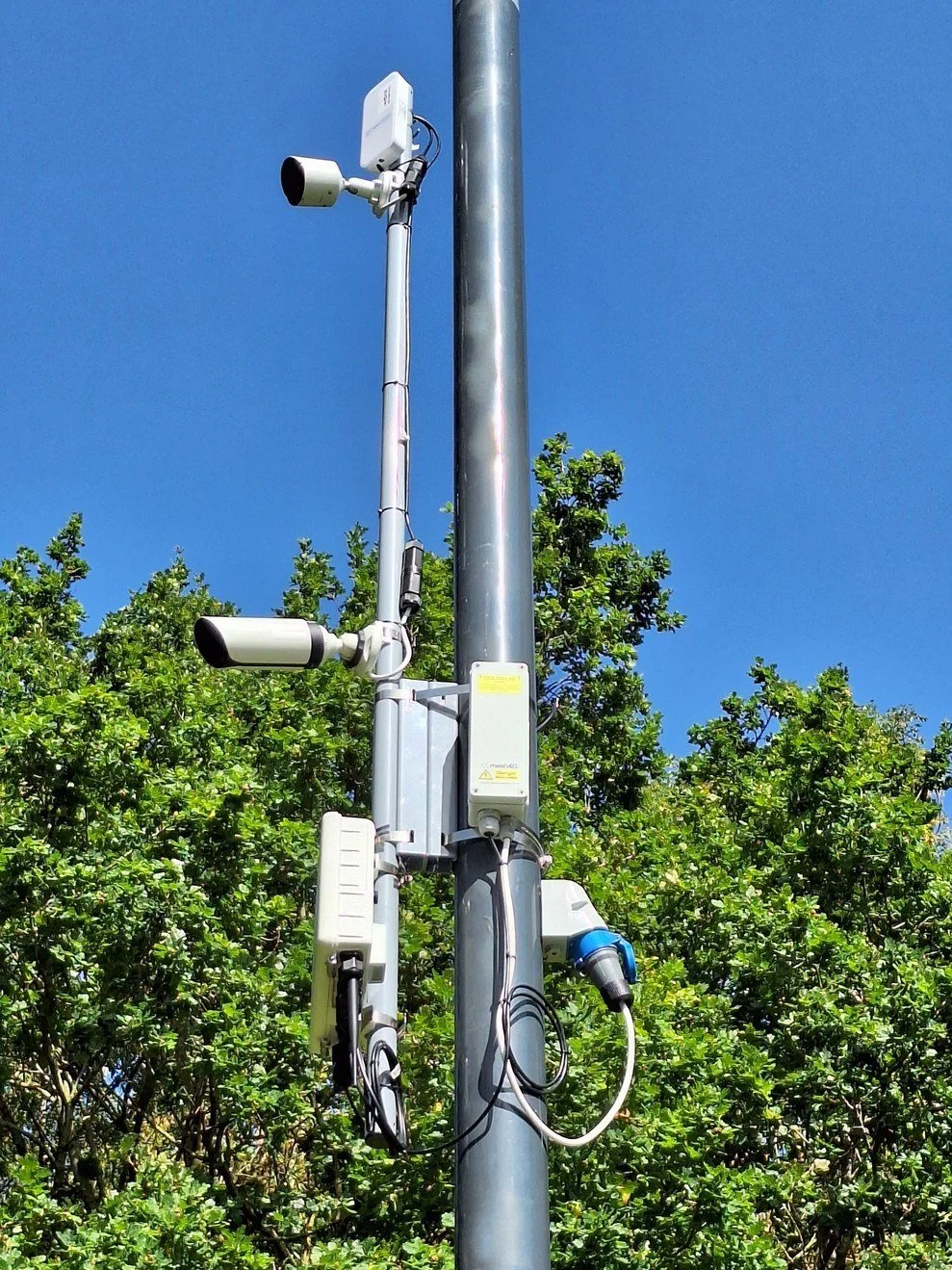
Fitted around the cameras already in place.
A structured pilot
Six to twelve weeks to an evidence‑based answer
The relevant question for police leadership is whether current systems reliably identify deliberate plate manipulation and, if not, what the intelligence cost of that gap is. A structured pilot in a high‑risk corridor answers it. The practical requirements are modest: a corridor with existing ANPR and CCTV coverage, a defined trial period, a nominated operational lead and data protection officer, and agreed metrics.
- Metrics: detection accuracy, false‑positive rate, time to response, intelligence value of flagged vehicles through post‑stop outcomes and Police National Computer (PNC) checks
- NOW Wireless manages integration, configuration and analytical support throughout
- No new hardware to procure; data stays within the force’s own governance framework
- Full evidential and governance documentation provided as standard
Scope, integrate, trial, results — the Surrey trial provides the template.
Read the full white paper
Closing the ANPR Gap: protecting UK police intelligence from ghost plate evasion
The full paper covers the threat, the limits of conventional ANPR, how SenseTrace AI identifies anomalies, the Surrey Police trial in detail, governance and what a pilot evaluation involves.
Get in touch
Scope a pilot on your corridor
Talk to our team about a pilot evaluation calibrated to your operational environment and existing camera estate.