
Case study · Staffordshire County Council
Forecasting pollution an hour ahead — and moving the traffic before it arrives
Outside a care home on the inner ring road of Newcastle‑under‑Lyme, NOW Wireless used AI to predict NO₂ spikes an hour in advance and hold traffic back at a junction where the air disperses more easily. The spikes flattened. Journey times did not change.

Headline results


Background
A Live Labs project with one clear target
Staffordshire County Council won funding under the ADEPT SMART Places Live Labs programme, a Department for Transport‑funded initiative to bring digital innovation to local highways. The council worked alongside Amey, Keele University and the Connected Places Catapult; more than 130 small and medium‑sized businesses applied to address mobility and air quality challenges, and ten projects were selected. One of them was managed by NOW Wireless.
The brief was specific: improve air quality outside a care home on the inner ring road of Newcastle‑under‑Lyme. Reference‑grade analysers cost tens of thousands of pounds per site, and diffusion tubes report weeks after the event. The council needed sensors that were accurate, affordable and live — and a plan that improved the air without unduly delaying the traffic, because long delays simply move the problem down the road.
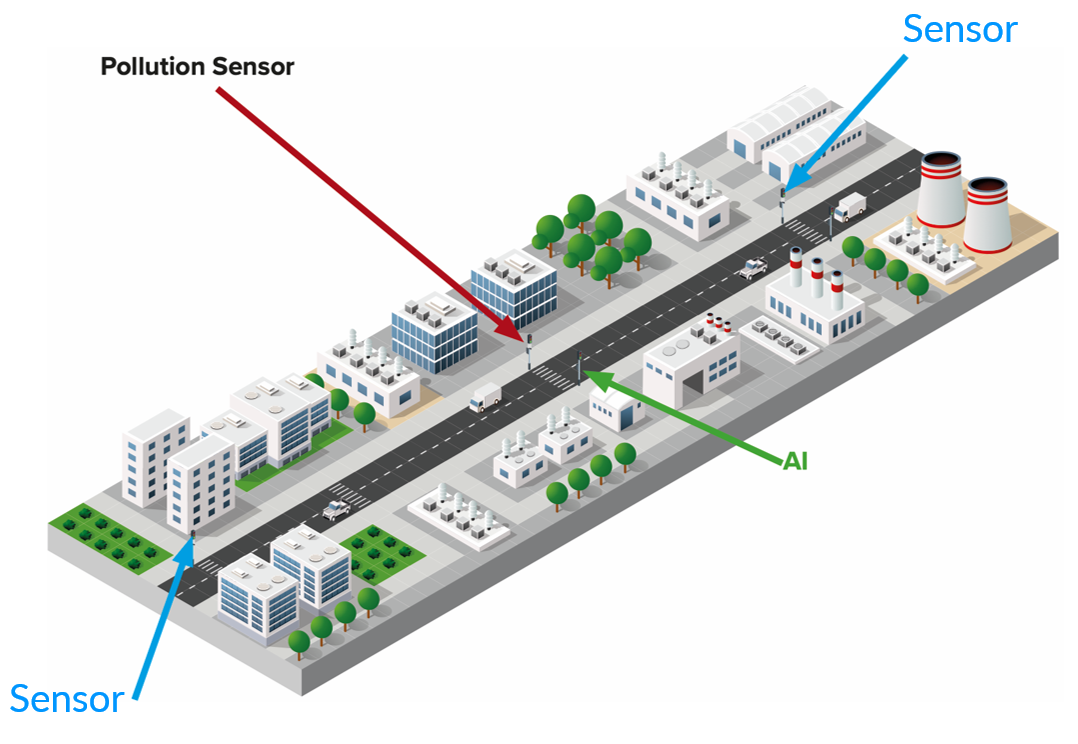
Sensors on the street, AI in the cabinet: the pattern used across the town.
Stage 1
Finding where to measure
Air quality detectors and digital‑signature journey‑time detectors were installed at eight significant points around Newcastle‑under‑Lyme. NOW Wireless AI then analysed the journey‑time data: using route analysis, it showed which routes through the town were busiest, and therefore where an air quality strategy would have most effect.
The route from Talke Road / Bradwell Lane to Lower Street / Church Street was clearly the busiest — and the care home sits at the second of those junctions. That made it the site to protect.
- Talke Road / Bradwell Lane
- Liverpool Road / London Road
- A527 / Basford Park Road
- Basford Park Road / Etruria Road
- A52 / Albert Street
- Lower Street / Church Street (care home)
- Newcastle Road / supermarket junction
- Clayton Road / Seabridge Lane
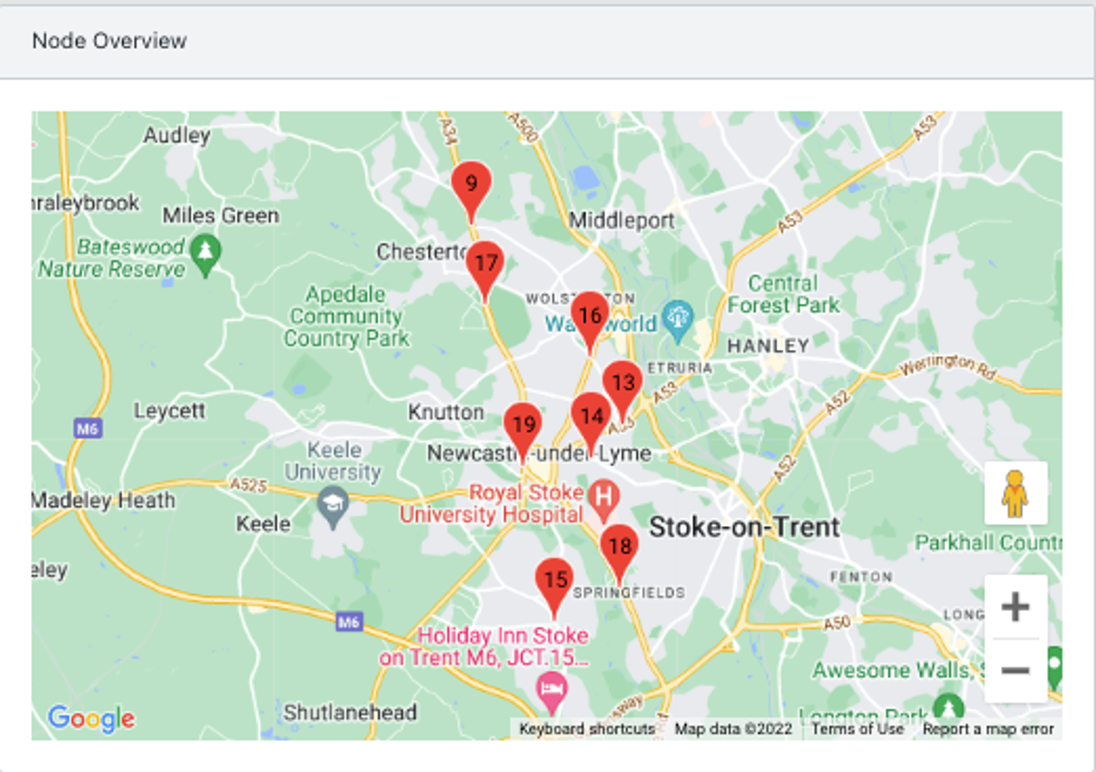
The eight sensor sites around Newcastle‑under‑Lyme.
Stage 2
Measuring the air in real time
The NOW Wireless NO₂ detector was installed at the closest point to the care home, with further sensors at the other sites. Every reading is recorded in SenseView, the NOW Wireless real‑time data platform, alongside journey times for each route and the weather — so pollution, traffic and conditions can be read together, live, and compared with any earlier period.
The two sites that mattered for the strategy were the care home itself and the junction one step out of town at Liverpool Road / London Road: more open, with a much higher dispersal rate for NO₂.
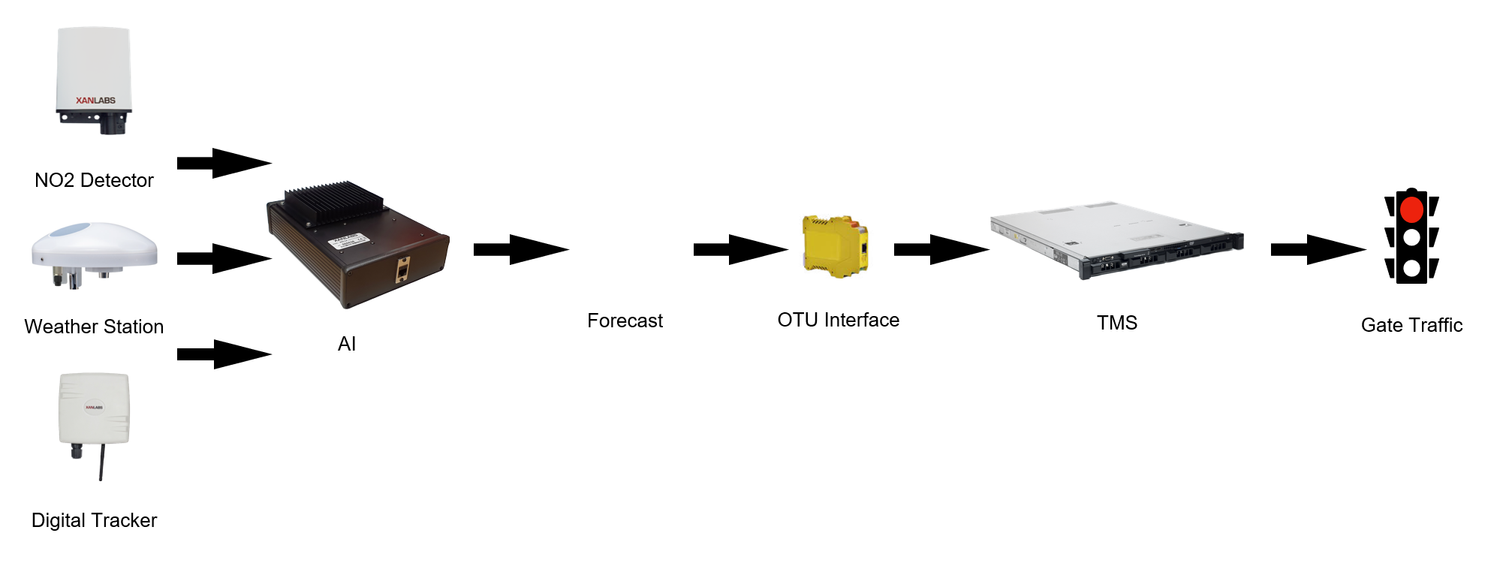
From sensor readings to a forecast, and from the forecast to a signal plan.
Stage 3
Gating the traffic before the spike
The strategy was to hold traffic back briefly outside the town, where a rise in NO₂ matters less, rather than let it queue beside the care home. Traffic was held 10 to 20 seconds longer than usual at Liverpool Road / London Road, and 10 to 20 seconds less at the care home site, through plans in the county’s traffic management system connected to the signal controllers on street.
What made it proactive was the forecast. Rather than reacting to a spike once it had happened, the NOW Wireless AI forecast NO₂ one hour ahead, incorporating weather and the other sensor data, and refreshed the forecast every five minutes. The gate was triggered by the forecast, so the spike was prevented rather than chased.
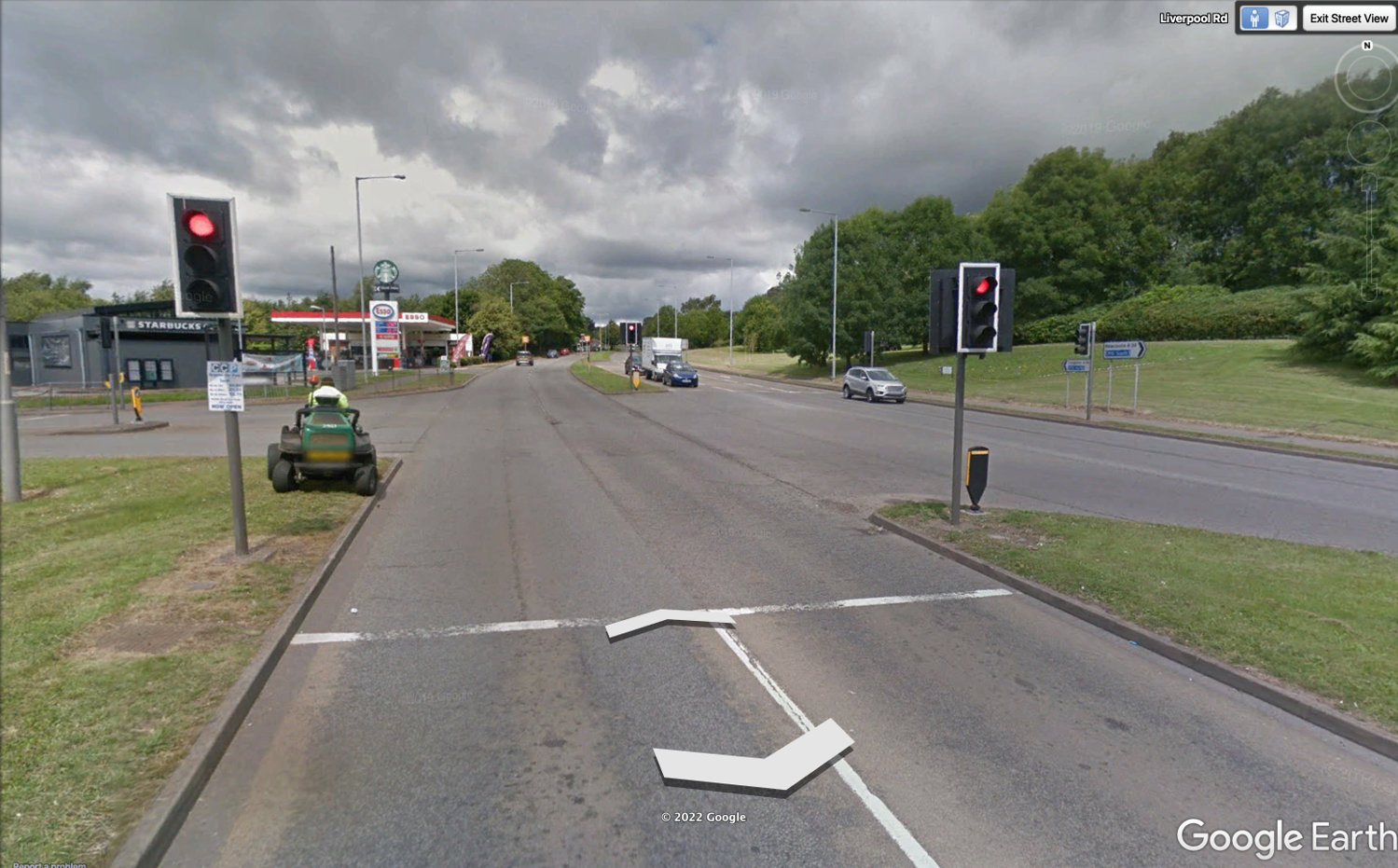
Liverpool Road / London Road — the open junction chosen for gating, one step out of the town centre.
Stage 4
Checking the results
Two things had to be true: journey times for drivers must not get longer, and NO₂ at the care home must come down. Both were measured continuously.
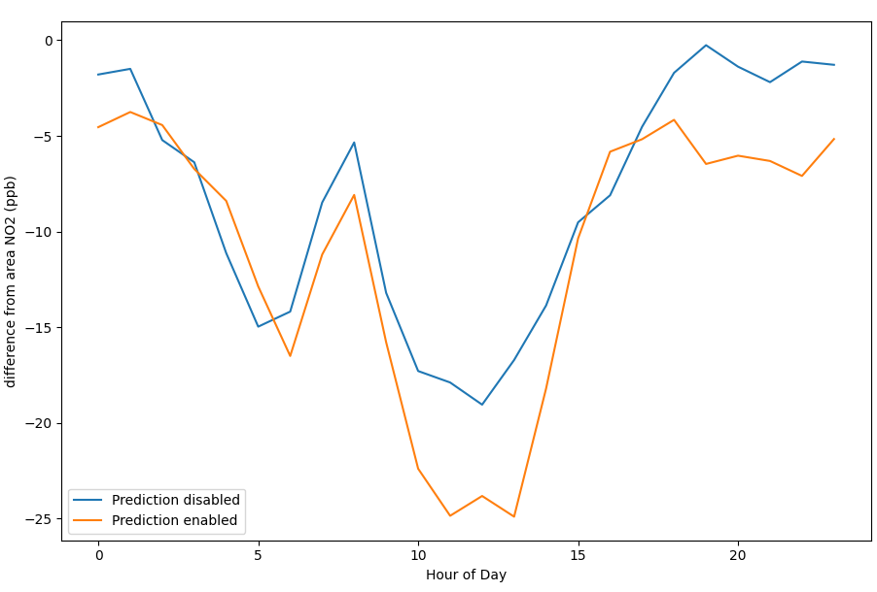
NO₂ at the care home by hour of day, forecasting on versus off: the spikes are flattened.
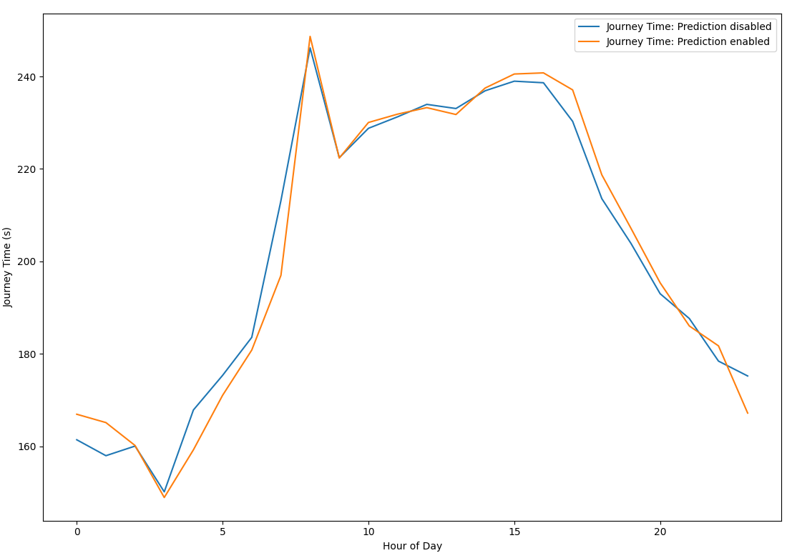
Journey time through the town, forecasting on versus off: effectively unchanged.
What the data showed
- At the morning and evening peaks, NO₂ at the care home was 3 to 5 parts per billion lower with forecasting enabled
- At lunchtime it was 7 parts per billion lower
- Overall NO₂ was not yet reduced, but the spikes — the moments that matter most to residents — were flattened
- Journey time for drivers showed minimal change
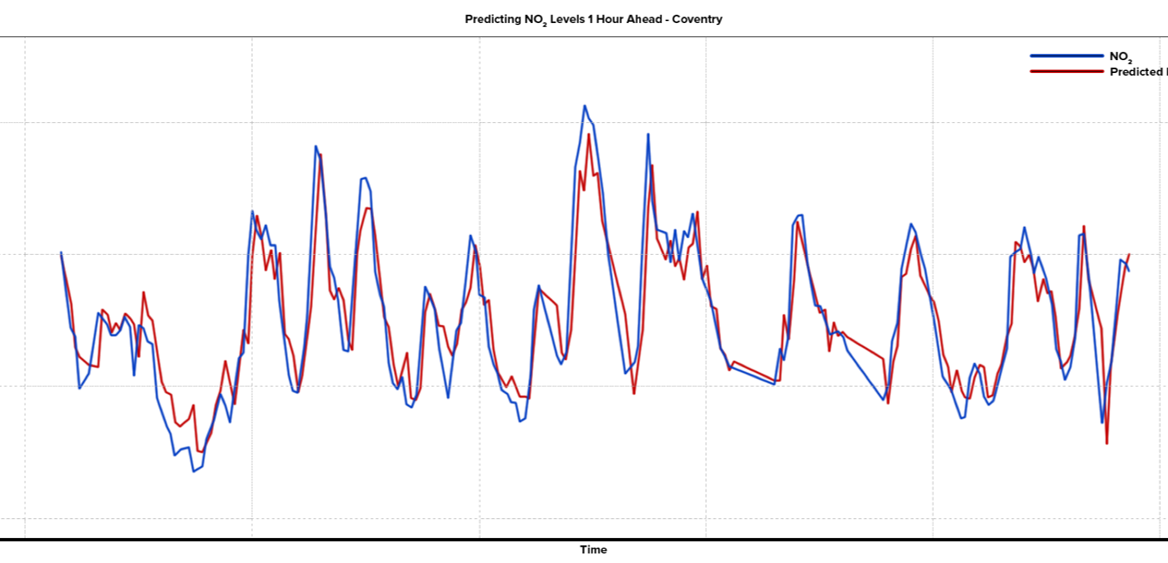
Forecast against actual pollution one hour ahead, from a comparable NOW Wireless deployment.
Conclusions and next steps
“Effortless, timely and productive”
That was the county council’s verdict on working with NOW Wireless. The main difficulty was creating the plans within the traffic management system, which was new to the council team; with that resolved, the next steps become straightforward.
- Longer gating times — from 30 seconds towards a minute — with CCTV and NOW Wireless AI queue detection raising an alert if queues build
- Periods with forecasting switched on and off, to quantify the effect further
- Gating at other sites in Newcastle‑under‑Lyme
- Particulates (PM2.5) monitored with the NOW Wireless particulate detector
- Roll‑out to other towns in Staffordshire, including Burton and Stafford
The system
- Sensors
- NO₂ detectors, journey‑time detectors
- Sites
- 8 across the town
- Forecast
- NO₂ one hour ahead, every 5 min
- Inputs
- Sensors, journey time, weather
- Action
- Gating plans in the county traffic management system
- Data layer
- SenseView
Built from the same products NOW Wireless supplies to every council: sensors, AI and the real‑time data platform.
What this means for you
Protect the places that matter most, without slowing the town
Schools, care homes and hospitals sit beside busy roads everywhere. The Staffordshire approach — measure, forecast, and gate upstream where the air disperses — works with the signals and the traffic management system a council already has. See Healthy Streets for the full method.
Talk to us
Which site would you protect first?
Tell us where the air quality objective is being exceeded and we will scope the sensors, the forecast and the gating plan for it.